Painter Patrick van Riemsdijk on finding energy in his Balearic hideaway
For painter Patrick van Riemsdijk, his Mallorcan hideaway provides the essential energy flow for his work.
Words Meena Sears
Photograph Sam Walton

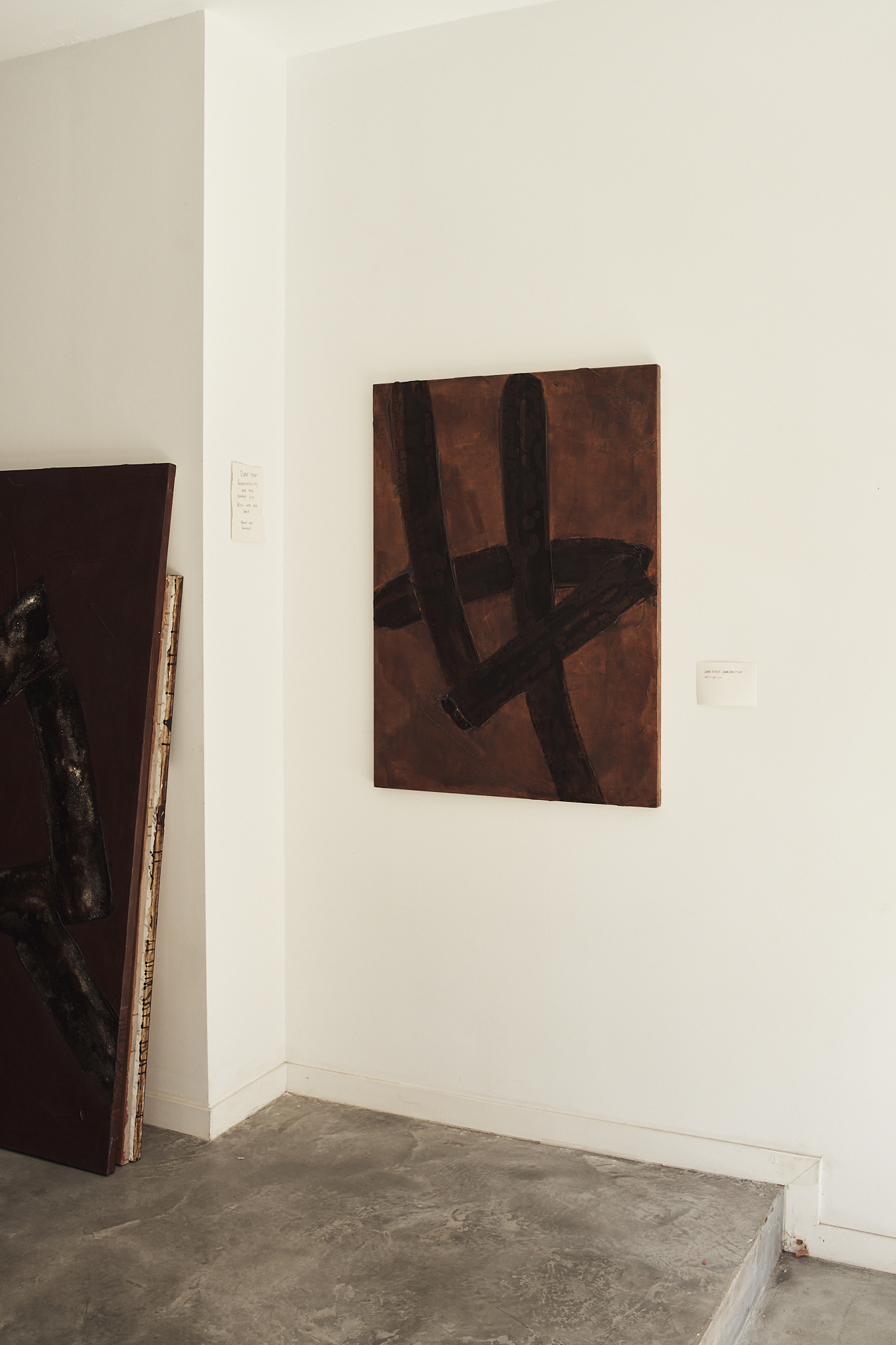
The Dutch-born abstract painter Patrick van Riemsdijk set up his atelier in Palma de Mallorca a year ago, when he and his wife had visited the island for a sabbatical, and found themselves irresistibly drawn to its ‘relaxed energy’. That word – energy – crops up a lot over the course of our conversation; the energy between painter and painting, painting and viewer, painter and viewer – but also the energy surrounding van Riemsdijk while he is working, and how that can affect the outcome of his project. For the 39-year-old, there is an energy release in every brush stroke. Be it large, sweeping lines that traverse the canvas from one corner to the other, or smaller, intricate ones that create delicate incisions into thick layers of paint, each contains a particular spirit, meaning and purpose.
‘Every time I finish a painting, I don’t want to sell it,’ he says. ‘And if I don’t have that feeling, I want to throw it away, because every piece should be special, every piece should capture a particular feeling, an energy.’ But it is not only the energy of its creator that is at play in an artwork. Van Riemsdijk believes that painting is an act of exchange, with the particular mentality, feelings and life experiences of each viewer affecting the energy they receive from the piece
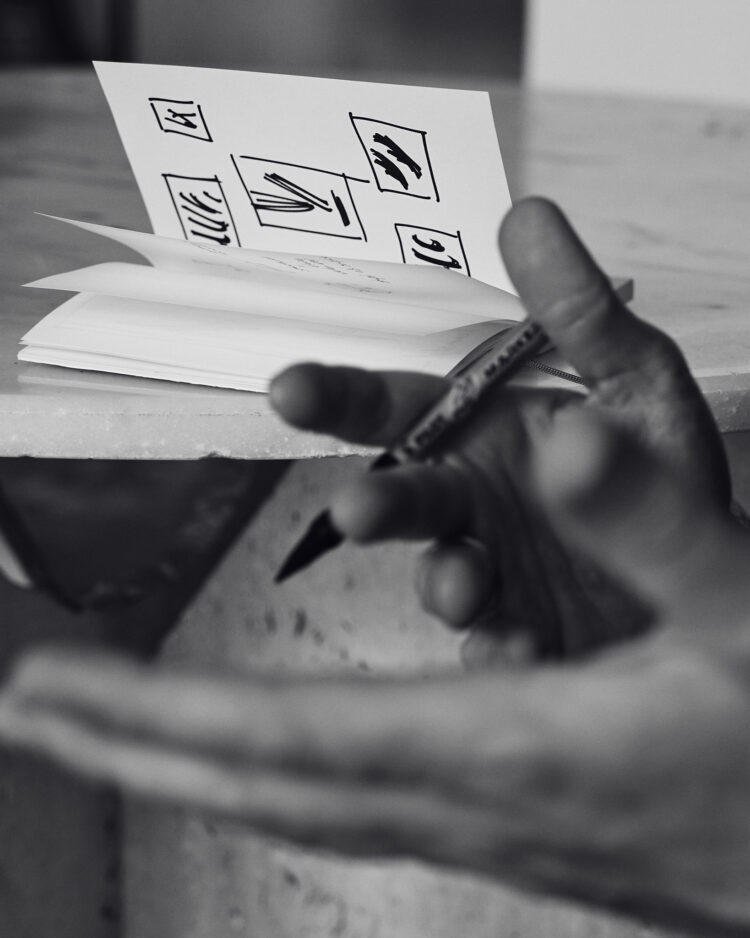
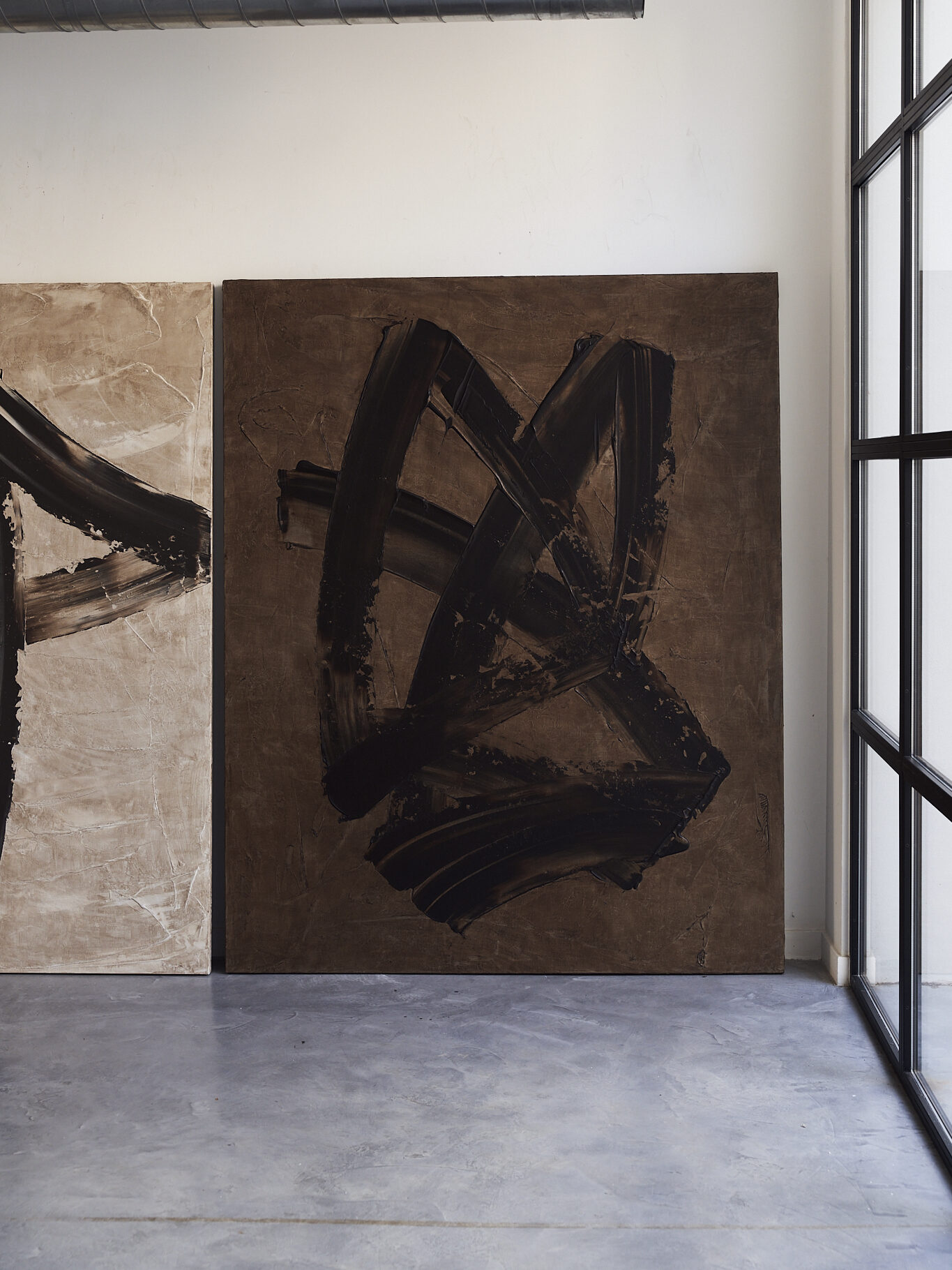
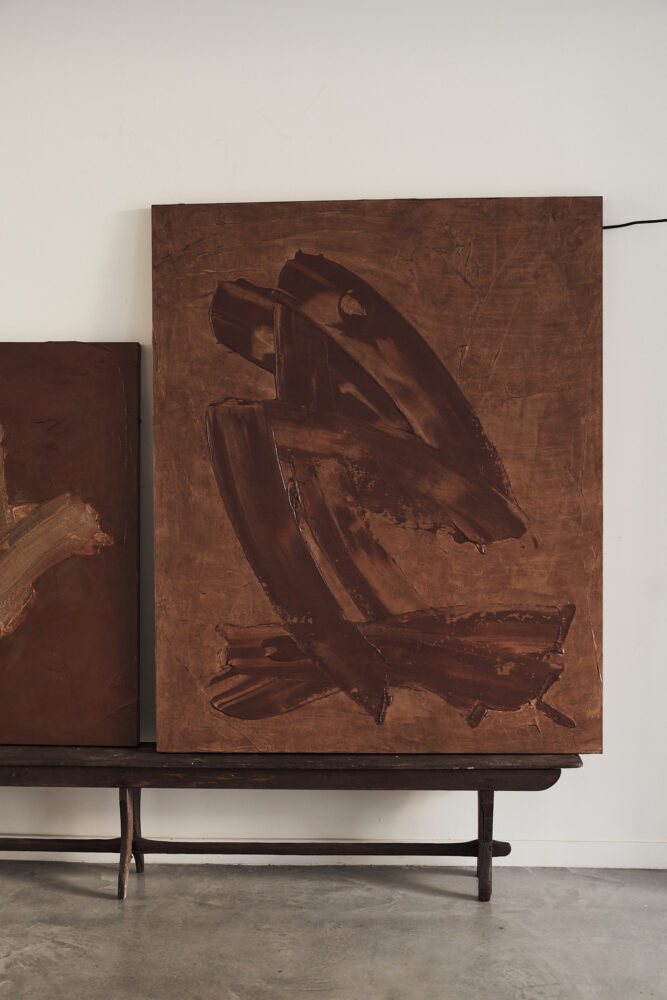
‘I used to worry if someone didn’t like my work, but now I understand that everyone has a different, personal relationship with it,’ says van Riemsdijk. And yet it is hard to see how anyone could dislike his work. Painted in rich, earthy tones, his large paintings look as though they might have occurred in nature, the spontaneous varieties in texture adding to this effect. That said, the shapes and patterns produced on the canvas are deeply expressive and highly suggestive, as if they are trying to reveal something – but it is never exactly clear what. A human body? A symbol? Or perhaps we are not supposed to find form in everything we see. Van Riemsdijk leaves it up to us.
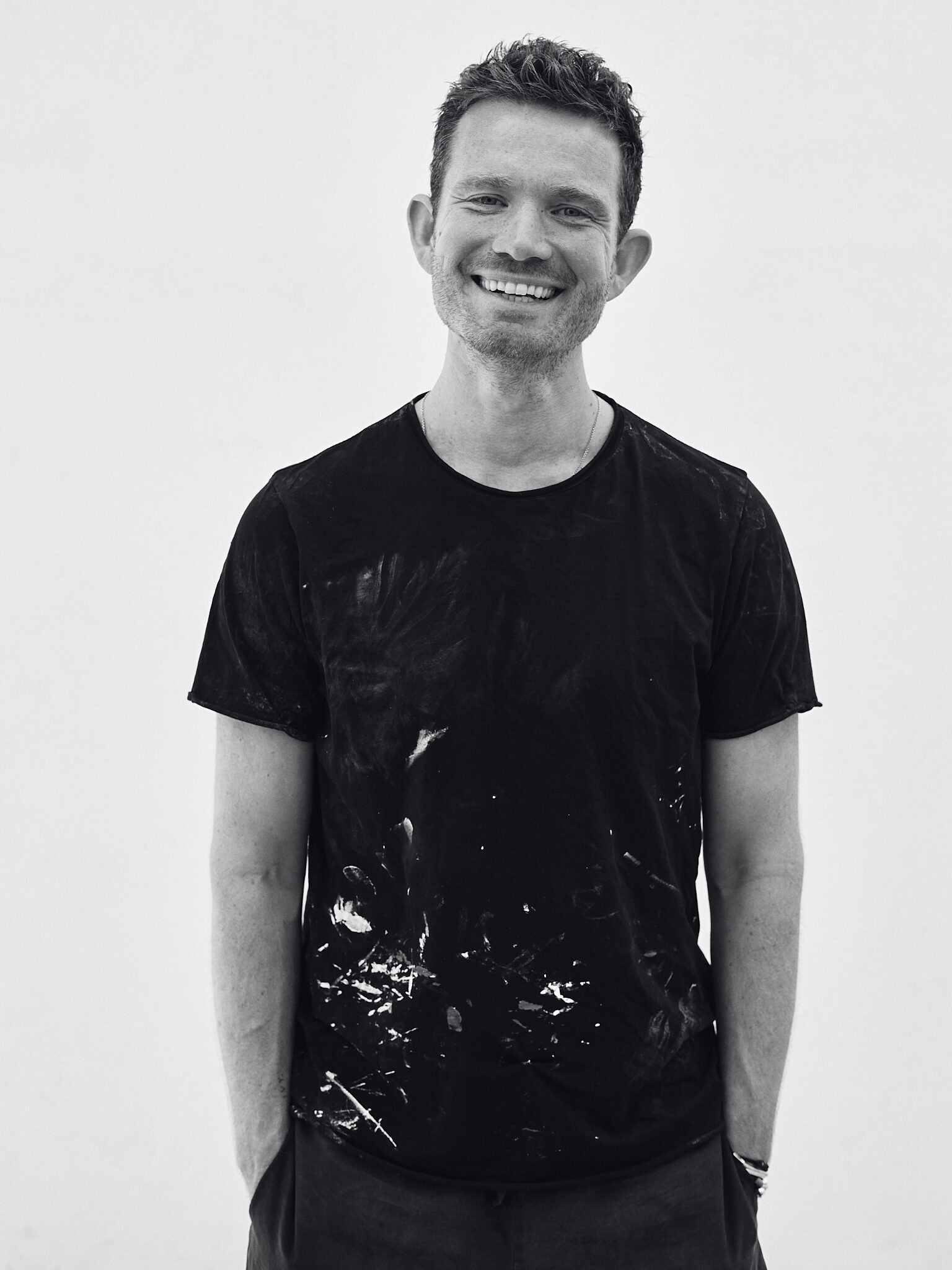
Born in Utrecht to a family of artists, van Reimsdijk moved to Amsterdam at the age of 20, where he lived and worked for 16 years. In 2022, he and his wife, Jasmijn Pieters, came to the Spanish island for what they thought would be a four or five-month sojourn. Enchanted by the Balearic mystique and magnificent nature, the couple ended up staying, finding a house in the Mallorcan countryside and settling into the island’s pace of life. ‘Everything is so slow in Mallorca, it’s always mañana, mañana, mañana – there’s no rush,’ he says. ‘I know it’s not for everyone, but I like to live like this.’
The artist set up his atelier in the barrio of Santa Catalina in Palma, a former fishing district centered around a centuries-old market. With a rich heritage of crafts, the enclave has become something of a hub for creatives on the island, with weavers, ceramicists, photographers and leather workers setting up their practices amongst the winding cobbled streets and faded pink and yellow houses. It is one of the many facets of his new home that van Riemsdijk enjoys, finding the abundance of innovation, artistry and talent that surrounds him a constant source of inspiration.
Van Riemsdijk’s studio is a large, light-filled space with floor-to-ceiling windows at one end leading onto an idyllic, white-walled terrace. Preferring not to work with galleries, he instead finds that his atelier serves as a place to create his work as well as to showcase it. Consequently, it has the familiar peacefulness of a gallery, while exuding the vibrant, sometimes chaotic, buzz of an artist’s studio.
We talked to van Riemsdijk about his atelier, and how he finds that essential ‘flow’ when working.
‘I love to be alone in my atelier – the dog is okay – but I need to be alone in my bubble’
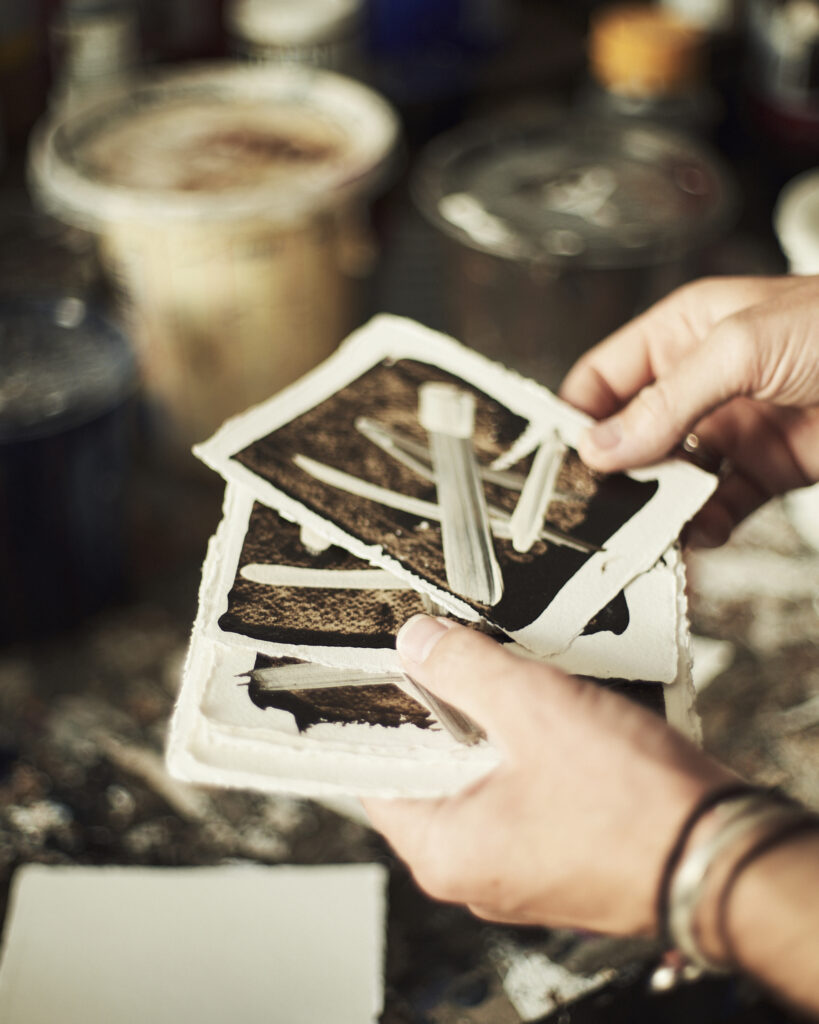
What aspects are important for you in a studio?
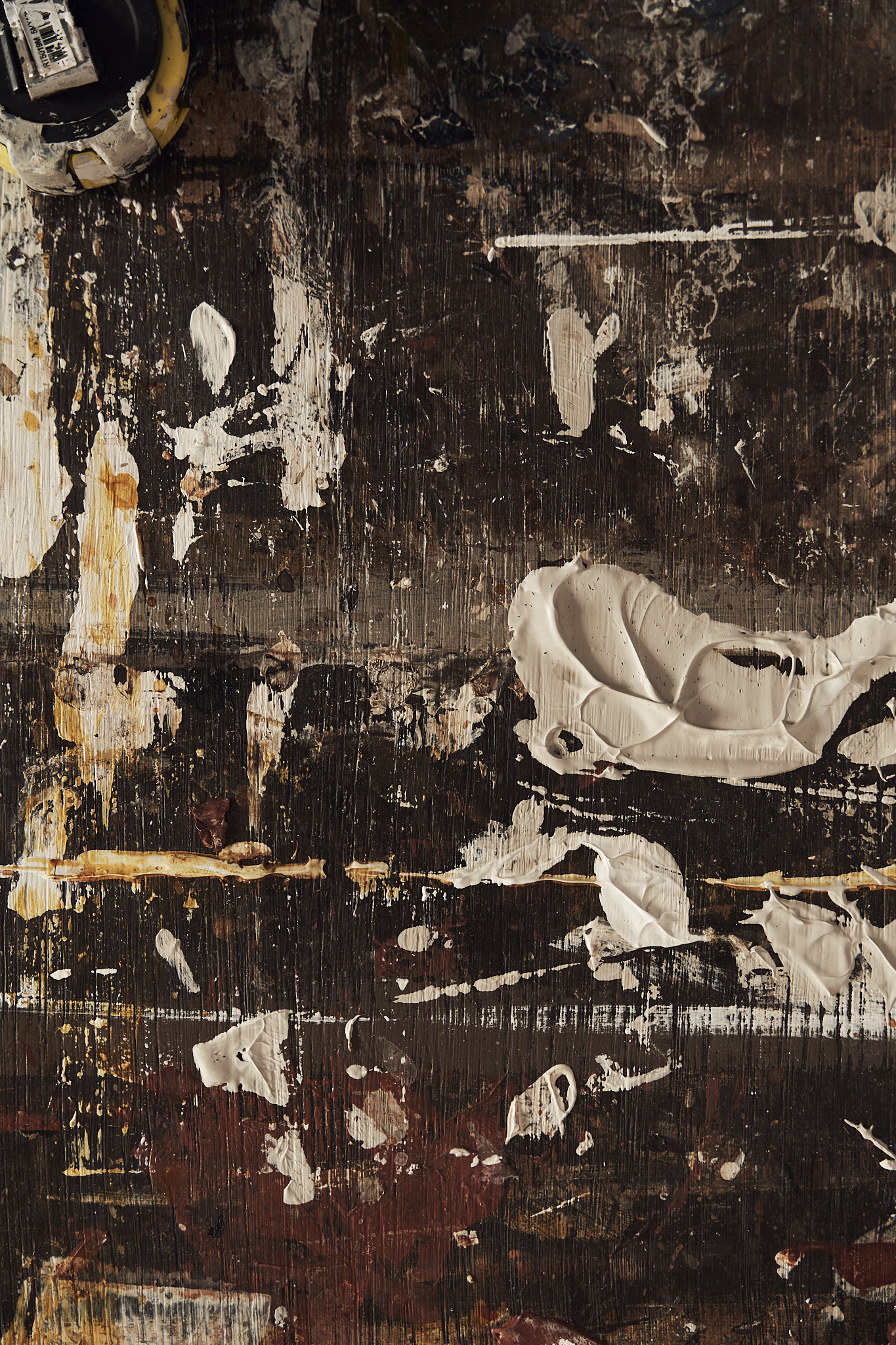
Daylight is important when creating my artwork. For me, it’s not possible to create art, specifically the colours, in unnatural light – it always comes out slightly different.
Do you like to work in private?
Sometimes, when your head is exploding and you don’t know which way you are going, it is nice to chat to other artists. But I love to be alone in my atelier – the dog is okay – but I need to be alone in my bubble. I need to have my own energy in the room.
Sometimes it can be vulnerable to create art, but if you are alone, you can be more open. If other people are in my studio I feel like I can’t give everything – I feel a bit stuck.
Is there anything else that helps you get into your ‘bubble’?
Incense, music, meditation – and sometimes I just lie on my work table for about 10 minutes.
Do you find that time goes slowly or fast when you’re working?
If I’m in my flow, it goes very fast, then sometimes you get a headache, or you forget to eat, or it gets dark. That’s my ultimate flow. Afterwards, you feel so happy but it also costs a lot of energy. And then other times, it goes slow.
A couple of years ago I would get really upset if I couldn’t get into the flow and I would say to myself, it needs to be done today. But now, I think it’s okay if I don’t get it done today: tomorrow is a new day, and I will try again. But the goal is always for time to go fast.

‘I believe that giving a painting the space to breathe allows it to come alive in ways that might be missed at first’
When you feel ‘stuck’ or encounter a challenge in your work, is there anything you can do to overcome that?
I’m really inspired by the Japanese philosophy of suiseki, which is where you look at a particular a stone for a really long time and notice new details and connect with its essence. Things go unnoticed with a quick glance.
I do the same with my art, both while making it and after it’s done. When I work on a piece, I spend a lot of time focusing on the small things, making sure it feels right, connecting with the flow of the artwork and the emotions it conveys. I believe that giving a painting the space to breathe allows it to come alive in ways that might be missed at first.
If you look at my artwork for just a few minutes, you’ll start to see new things, like hidden patterns or a certain energy. The longer you look, the more you’ll notice and feel. It reminds me of how, in Japan, they find beauty in small, simple things, and the more time you spend with it, the more it reveals to you. This patient observation is something I try to bring into my art, letting people see deeper the longer they look.
Do you think that your studio is a physical representation of your mind?
Yes, sometimes my studio is very clean and everything is in its place, and sometimes it’s a total mess and everything is everywhere, but I think that’s also like my mind.
Do you go anywhere else to get inspiration?
There’s so much colour in Mallorca; different colours in the sky, in the sun and in the stones. I didn’t realise how much of an impact it would have on me until I got here.
Within my work, I always start with colour. For example, a couple of weeks ago I found some stones while hiking, and I now have three artworks in the colour of the stones.
Is it important for you to have somewhere to escape the hustle and bustle of everyday life?
Being in nature helps to clear my mind. Right now [September], it’s very crowded with tourists in Mallorca, but when it’s less busy, you can go to the beach when there’s no one there and you can just sit and listen to the ocean and the birds.