How artist and architect Craig Bamford created his own meditative hole-and-corner
Artist, architect and master craftsman Craig Bamford tells us how he created a house for reflection and meditation on the Lizard peninsula in south Cornwall
Photograph Craig Bamford
Craig Bamford’s multi-disciplinary practice, which spans architecture, art and furniture design, is united by a belief in the power of materials to alter mind states. His London-based studio, SASA Works, is the manifestation of this philosophy, creating bespoke pieces from chairs, tables and sculptures to homes and studios that reflect Bamford’s desire to create healing spaces through craft and what he calls ‘elemental building’.
When Bamford met Adam Weismann, co-founder of natural plaster manufacturer Clayworks, last autumn, the pair hit it off straight away, discovering many parallels between their design philosophies. So, when Weismann launched Claymoon, a new collection of handcrafted, clay artworks, it was only natural that SASA Works would be commissioned to create a building suitable to house the pieces.
Claymoon was designed to encourage ‘soft fascination’, a concept borrowed from Esther M Sternberg, MD, author of Healing Spaces: The Science and Place of Wellbeing. It describes the way elements in nature such as birdsong or moving clouds can capture our attention, allowing the space and time for other forms of thinking to enter our minds, such as reflection and meditation.
Tasked with creating an environment that would foster this effect, and enhance the purpose of the clay artworks to induce ‘soft fascination’, Bamford sought to give architectural form to the elements of nature. The resulting Moon House, is a retreat from everyday life, a space for visitors to disconnect and enter a state of reflection, mediation or contemplation – a hole-and-corner, you might say.
Can you describe your hole-and-corner?
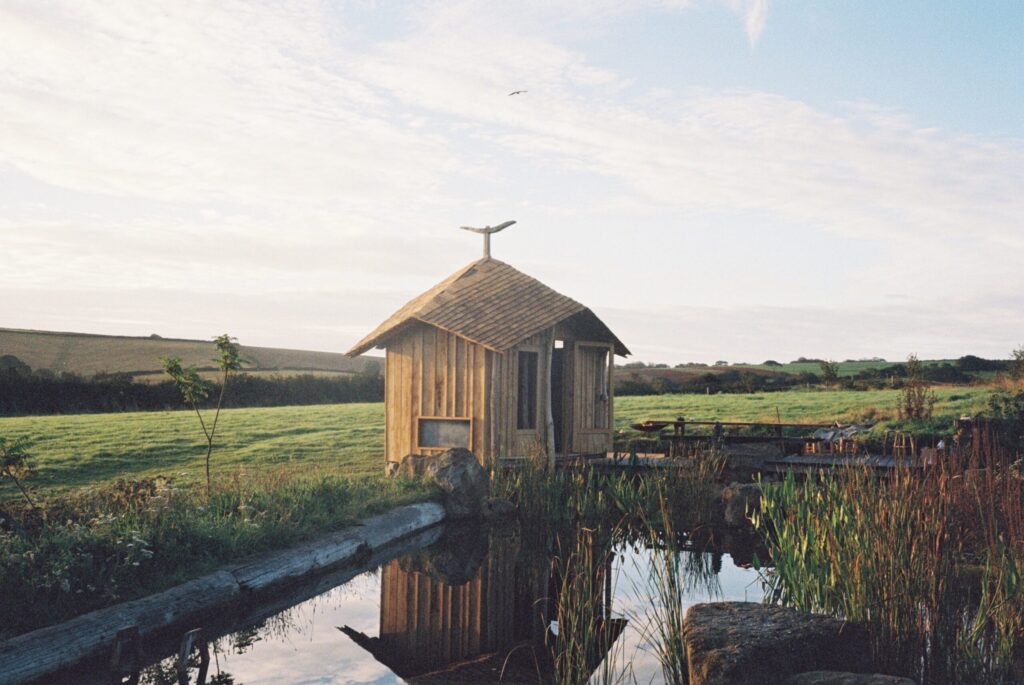
The Moon House is located in a field near the village of Manaccan, on the Lizard peninsula, in south Cornwall. It sits on a bit of stone, perched at the edge of a natural swimming pond.
The frame and floor are made of chestnut from the same woodland; we washed the wood for the floor with iron to bring out a blue that reflects the nearby waters. The roof is clad with hand-cut oak shakes and the walls are clad in oak and chestnut. I made some oak wings to sit on top of the roof; they act as a gesture to the visiting buzzards and an offering to the sky.
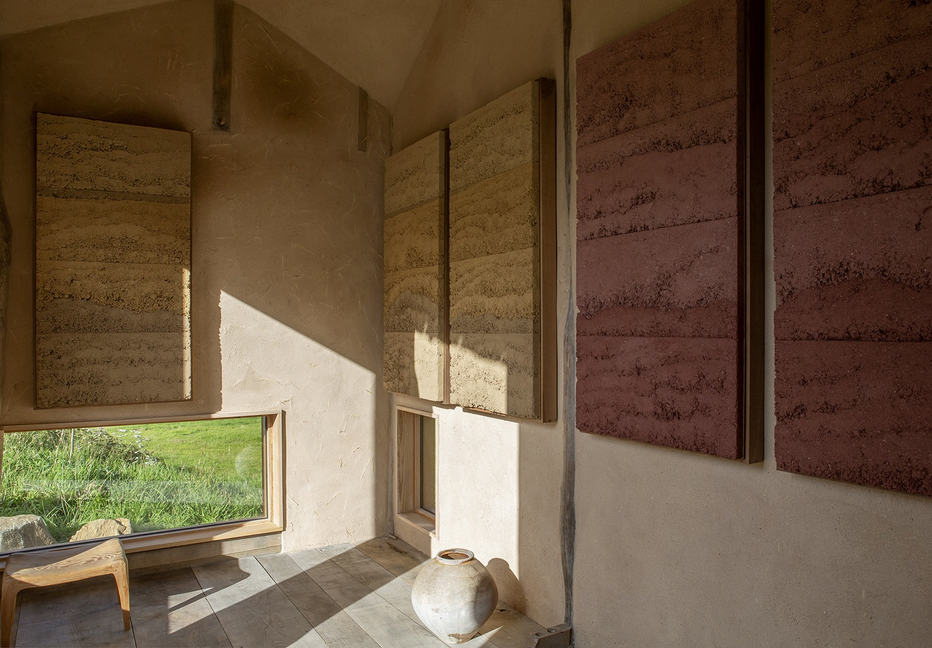
Adam lined the interior with a beautiful Clayworks plaster; threads of golden straw are interspersed throughout the surface. There is also a ceramic vessel by Nancy Fuller inside.
What is the Moon House for?
It is a space for meditation and stillness; a place to contemplate the surrounding nature, to pause before and after a freshwater swim, or to watch the rising sun and the resting moon.
It is also a special viewing place for some of the Claymoon pieces made by Adam. A place where he can bring the occasional client to experience the pieces with an accompanying tea ceremony or swim.
What experience do you hope visitors to the Moon House will have?
I have been interested in the philosophy behind Japanese tea houses for a long while; how these spaces foster both an elemental and ceremonial experience in the humble act of drinking tea. They are spaces that often have something poetic about them. The Moon House was inspired by those ideas, and so, ideally, visitors to the Moon House will be calmed by a similar experience that grounds them and brings them to a place of stillness.
How did you design the Moon House to ensure its purpose was fulfilled?
The Moon House was crafted by hand, so it is inherently sculptural. It is an elemental building; one brought into being for a poetic function that becomes practical and not the other way around.
In a way, every element has a house, a place where it can be entered and experienced. We sought to give architectural form to the element of the moon through this building; the moon being a place of serenity, mystery, intuition, quiet daily wonder, and humble majesty. We want visitors to the Moon House to approach it like a daily pilgrimage that allows them to become attuned to the qualities of the moon – there is also something about the journey to get to the Moon House, in the depths of Cornwall, that adds to this experience. So, the Moon House is a place of ritual, a place of healing.
Why was it important for you to use natural materials?
Using natural materials allows the building to become an extension of the landscape. Natural materials carry their own qualities, their own energies, their own senses of time, and their own memories that can be worked with and welcomed into that space.
Can you describe your design process?
My design process involves a lot of meditation and contemplative walks. I draw the plans by hand, which I feel helps with the sculpting of a space. I spend a lot of time tuning in to the surrounding landscape, noticing the existing elements in nature so that the building feels like it has always been there. I think that the direction of, and approach to, a design is as important as the final space because the journey is always so much a part of a place.
I also often get involved with the construction side of things too, and spent many summer days building the Moon House alongside many talented hands.
What elements do you think make the perfect hole-and-corner?
A sense of stillness, and a connection to a time outside of conventional time, a time that is vast and ancient.
What might we expect to hear when visiting the Moon House?
It depends on the time of year and the time of day. On a calm summer evening, you might hear the evening swallows chatting to each other as they dive in beautiful arcs to drink from the pond, or the rustle of a soft breeze in the trees. You will always be accompanied by the sound of running water.
In winter, the sound of rain pattering against the roof will make the interior even more special as the clay walls and ceiling lend a soft interior resonance that enhances that sense of stillness.
What would we sit on?
One of two stools that I have made; one from Douglas fir and the other from oak. Or a cushion.
Does it feel like home?
To me, a home is always a feeling of stillness – so yes.
How do the Claymoon panels complement the Moon House?
In quiet conversation about land, place and time.
sasaworks.co.uk | clay-moon.com