Niyi Okuboyejo on the creative process behind his fashion brand Post-Imperial
Niyi Okuboyejo is a Nigerian-born fashion designer currently based between Houston, Texas, where he lives with his family, and Harlem, New York, where the garments for his menswear brand Post-Imperial are made.
Words Meena Sears
Photograph Osa Uwubanmwen
Niyi Okuboyejo is a Nigerian-born fashion designer currently based between Houston, Texas, where he lives with his family, and Harlem, New York, where the garments for his menswear brand Post-Imperial are made. The name Post-Imperial, Okuboyejo tells me over Zoom from his home office, comes from the idea of creating something for today and for the future, and not looking to the past for design inspiration. ‘Nostalgia is often present in fashion design but, as a person of colour, I feel that nostalgia paints a misconception of the past. I wanted to create something that moved beyond the history of colonialism, imperialism and the impact of that.’
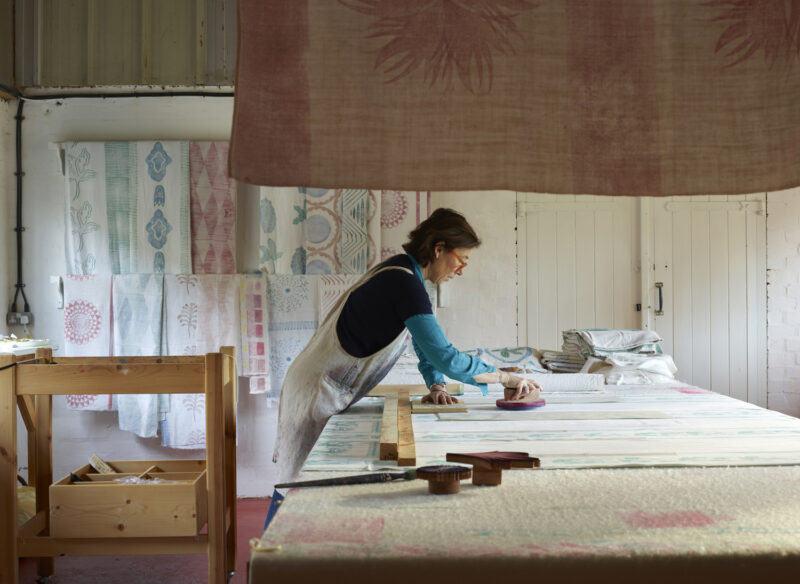
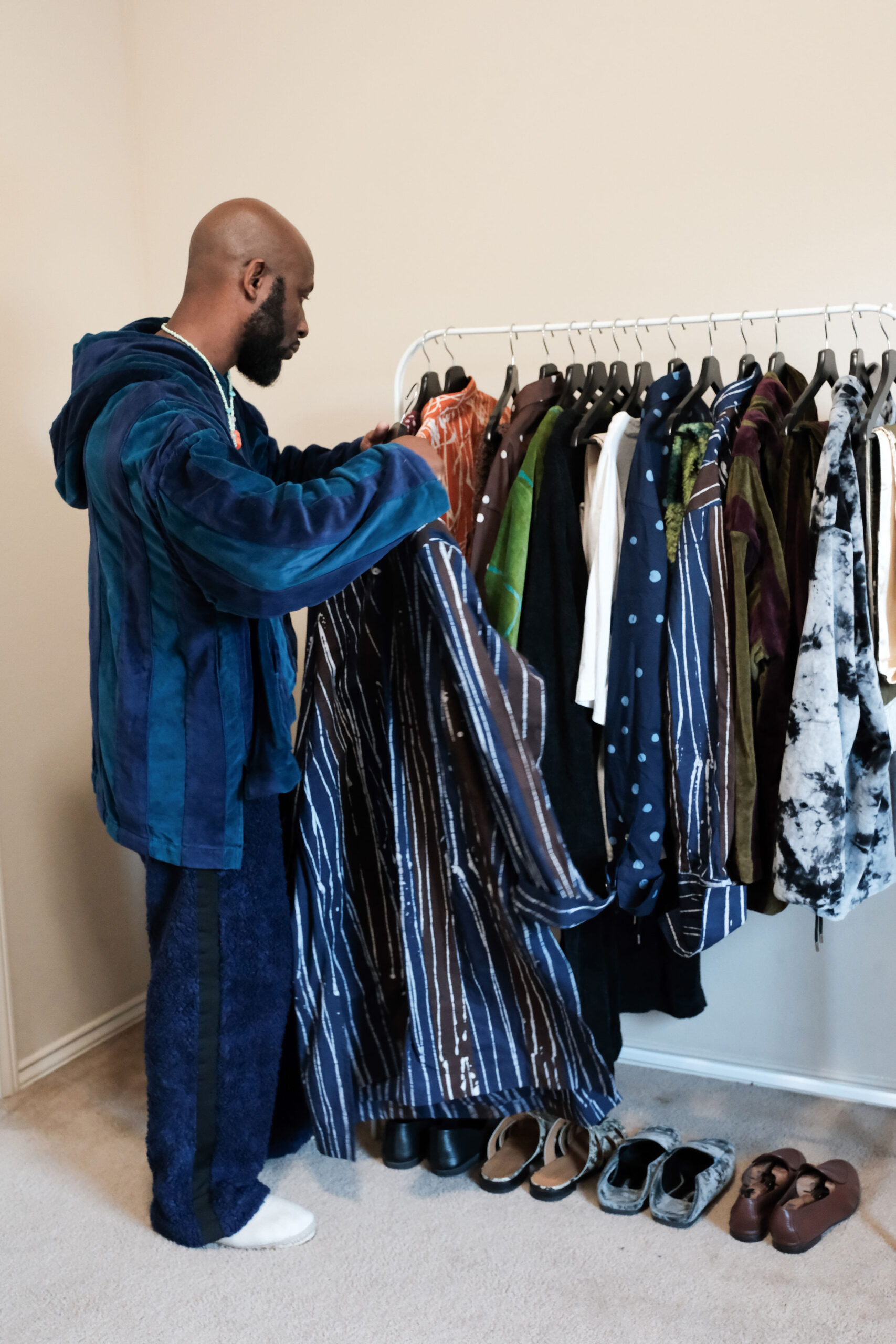
It was while studying Fashion Design at Parsons School of Design in New York between 2007 and 2010 that Okuboyejo first began to think of how he could do that. ‘There are enough clothes in the world already, so you have to give a reason as to why your idea needs to exist.’ For Okuboyejo, that purpose would be found on a trip to Lagos, where he lived for the first 14 years of his life. Reminded of the adire dyeing technique – an ancient Yoruba practice where fabrics are hand-painted with cassava starch paste (which resists dye) before the colour is applied to create amazing patterns – Okuboyejo saw an opportunity to merge a traditional African technique with more Western designs. ‘Adire dyeing is so common in Nigeria, but I hadn’t really seen it done in the United States. So I started to collaborate with the artisans there to create adire dyed neckties.’
Proving popular back in the US, Okuboyejo eventually expanded into clothing, creating a range of innovative pieces that seamlessly blend the vibrant colours and abstract patterns of adire dyeing with modern shapes and sensibilities. The fabrics are dyed at one of three to four dye houses that Post-Imperial works with based between Lagos and Osogbo – about five hours outside of Lagos – before being shipped to New York for tailoring. Since its inception in 2015, Post-Imperial has collaborated with the likes of fashion designer Daiki Suzuki of Engineered Garments and materials translator Seetal Solanki of Ma.tt.er, and Okuboyejo was awarded the Fashion Group International Rising Star Awards in 2020.
Our conversation feels easy and natural, a product of Okuboyejo’s informal vibe; he sits comfortably on his sofa as we speak. Despite two glass screens and many miles between us, I can sense Okuboyejo’s enthusiasm to convey the depth of meaning behind every decision that goes into Post-Imperial. ‘At Post-Imperial, we design through a model called Empathic Design, which is a collaborative approach to design, that entails designing with three factors in mind; people, materials and culture.’ I am intrigued to find out more about this process, and how Okuboyejo has intentionally designed his home studio to create a ‘nexus of constant inspiration’.
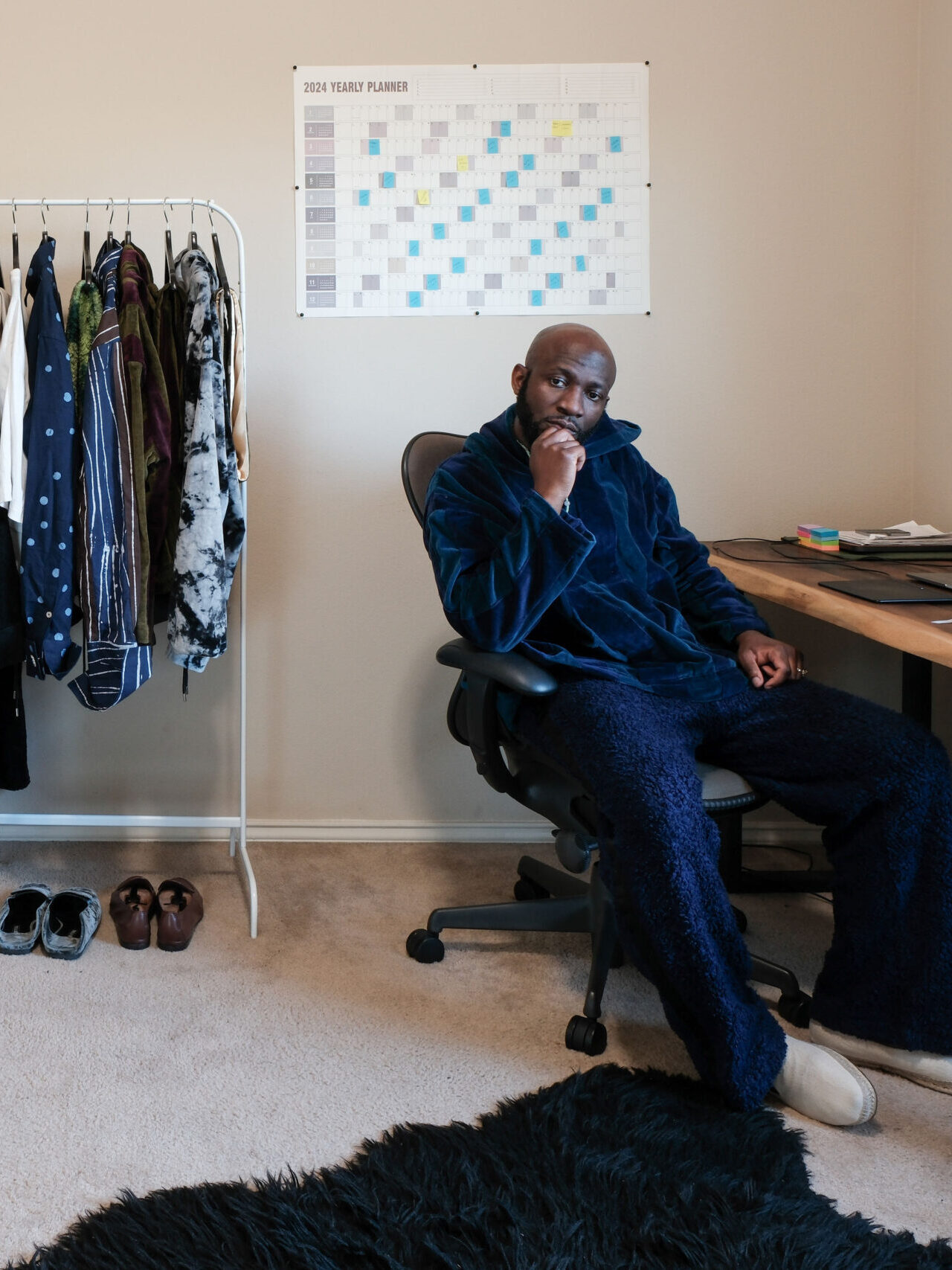
You’ve described your home studio as a ‘nexus of constant inspiration’; how have you created that?
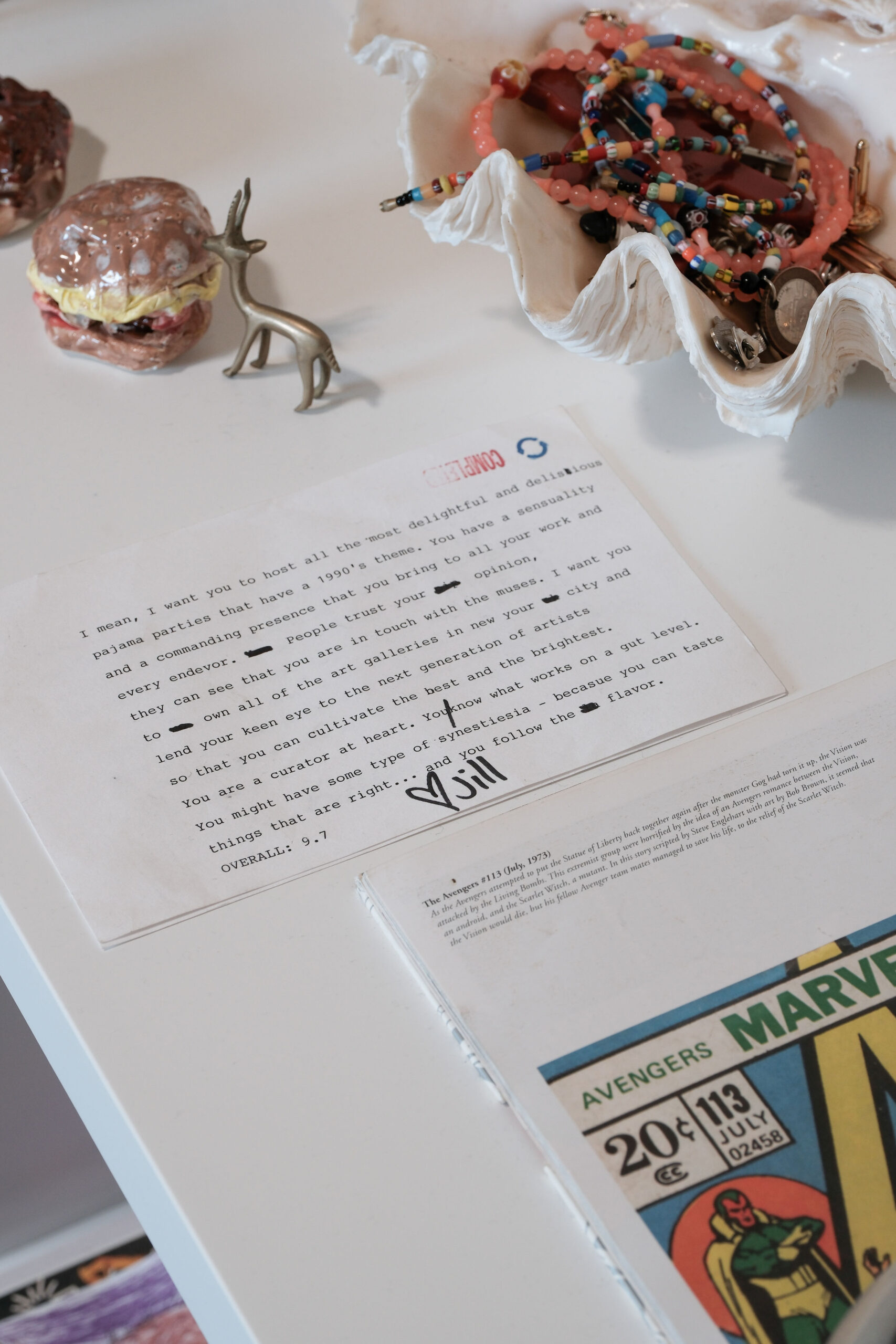
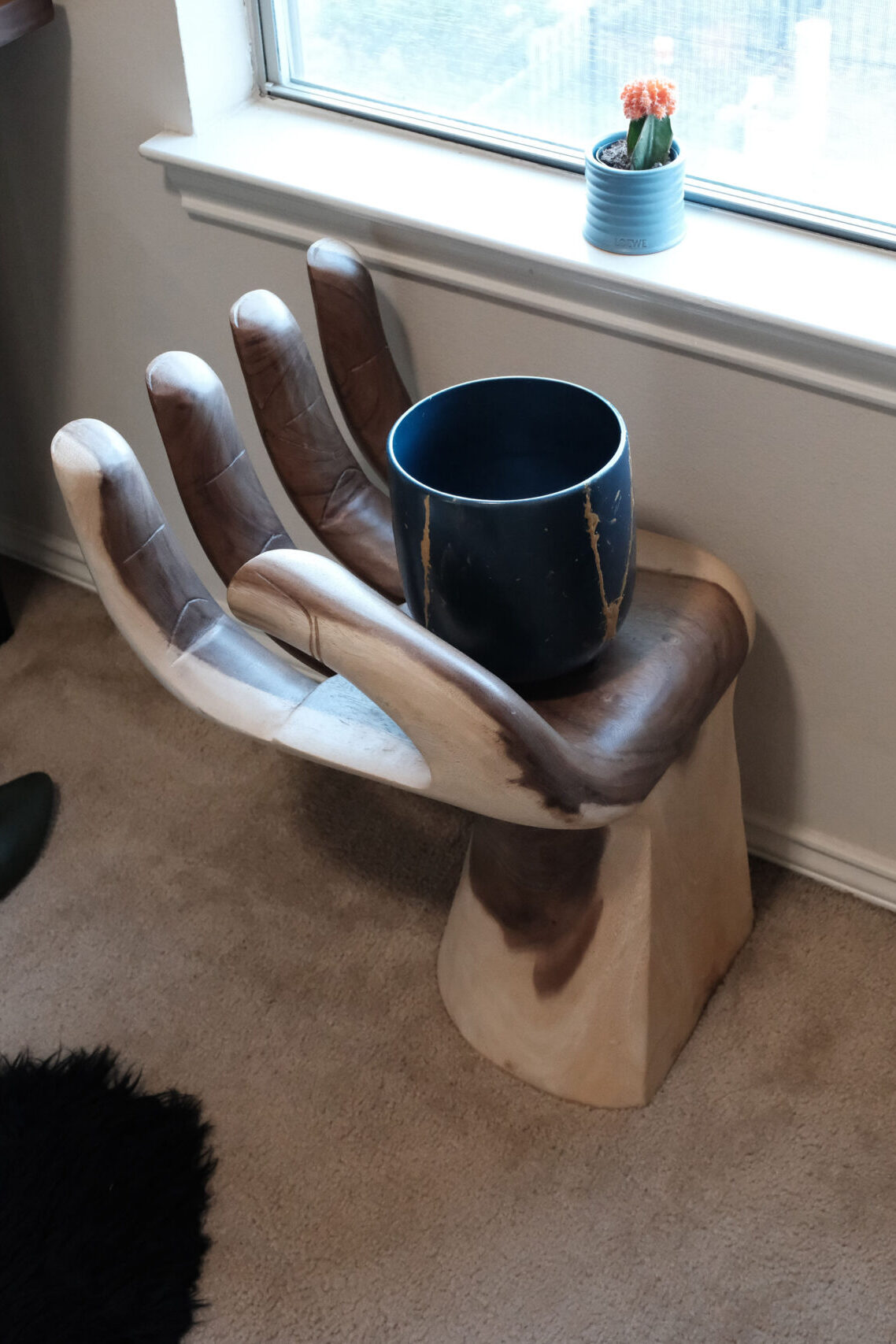
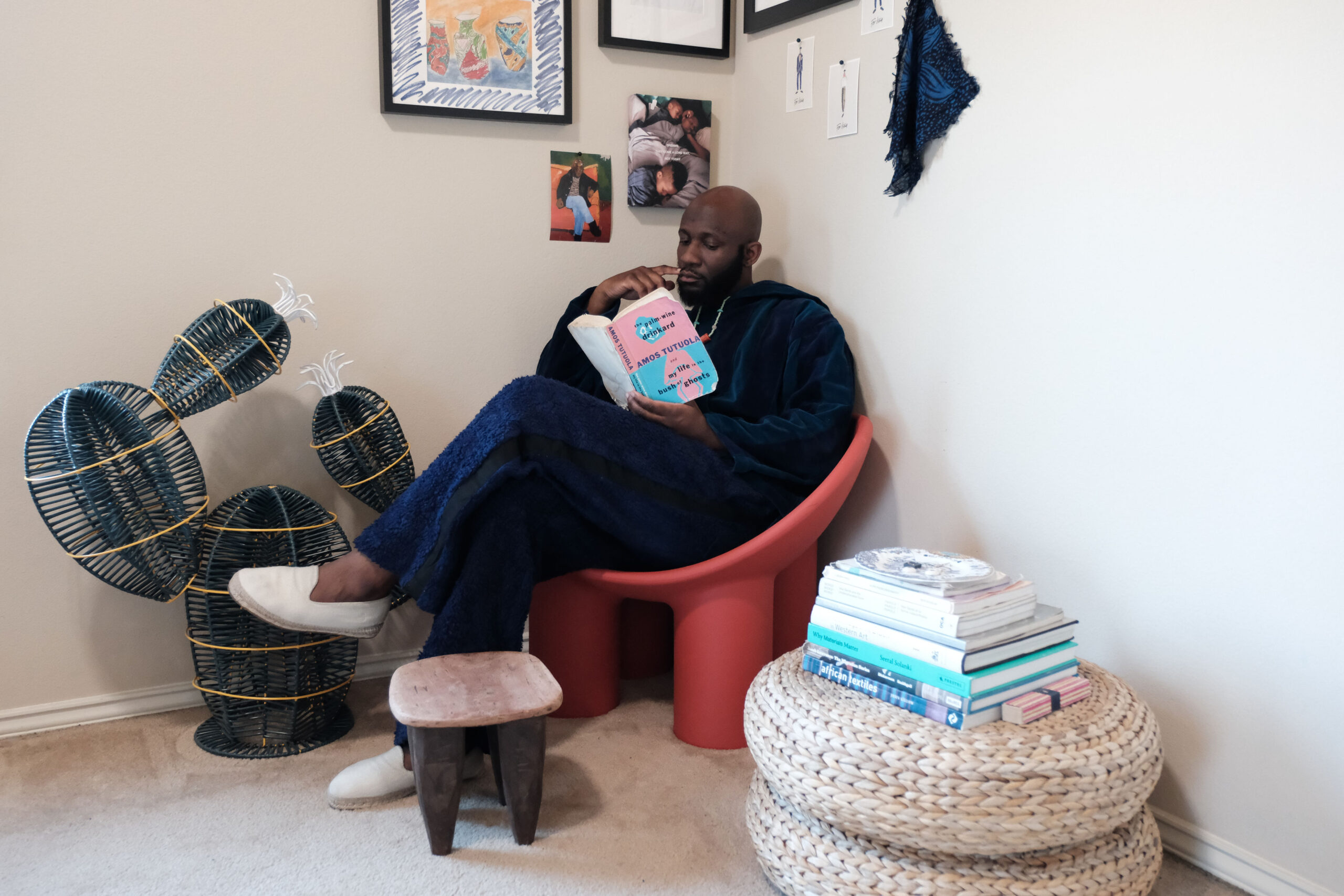
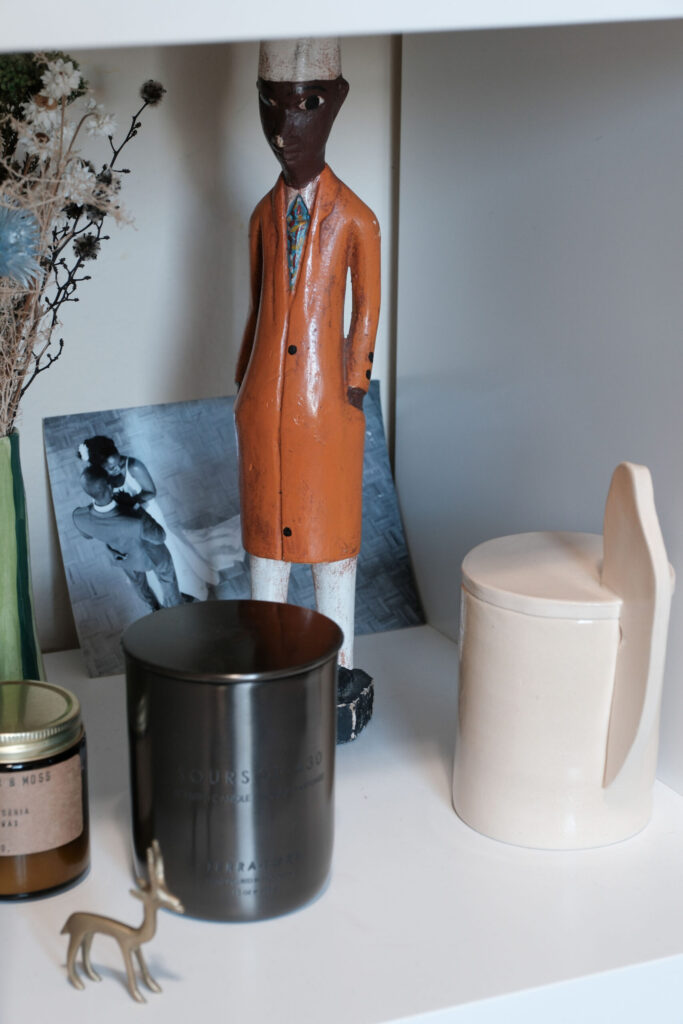
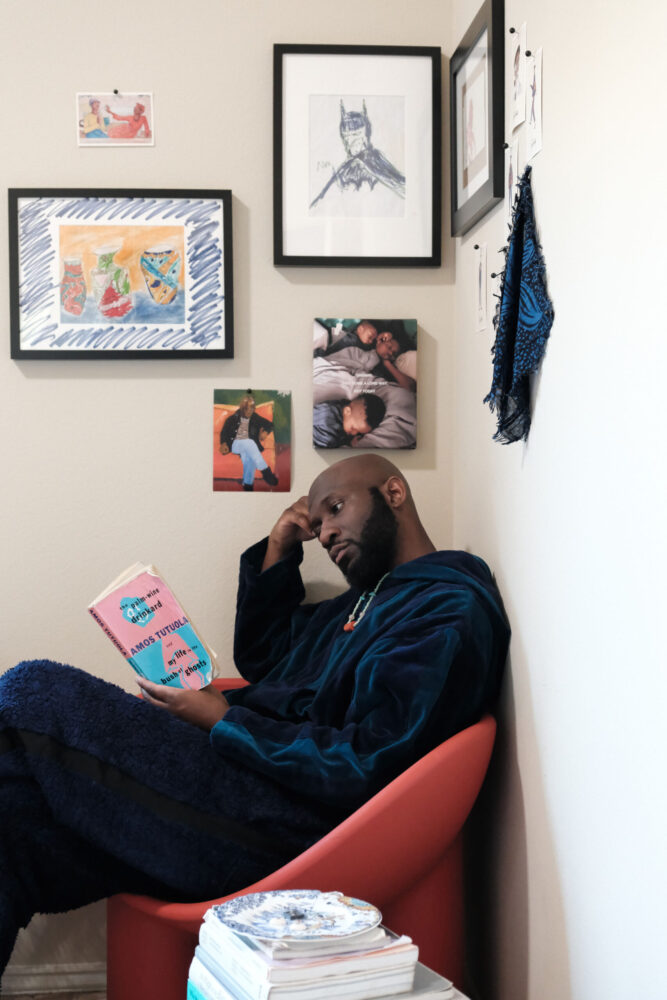
Just as I intentionally dress my body with beautiful things, I intentionally decorate my home office with beautiful objects. Some of these things include a small wooden Senufo stool, a sculpture of a cactus handmade by artisans in Colombia, a kintsugi pot, and a chair from Faye Toogood (the Driade – Roly Poly armchair in red), which my wife bought me for my birthday.
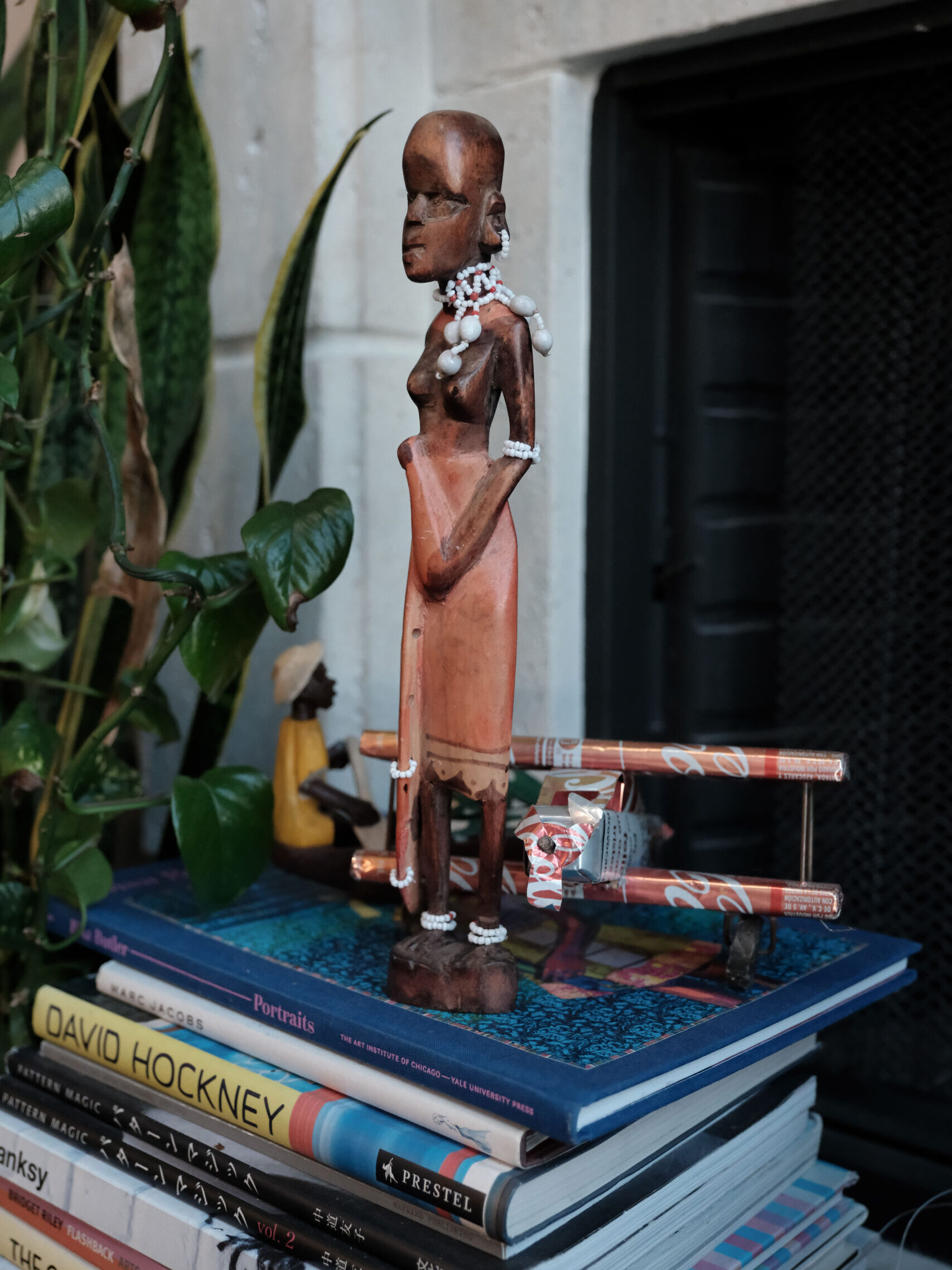
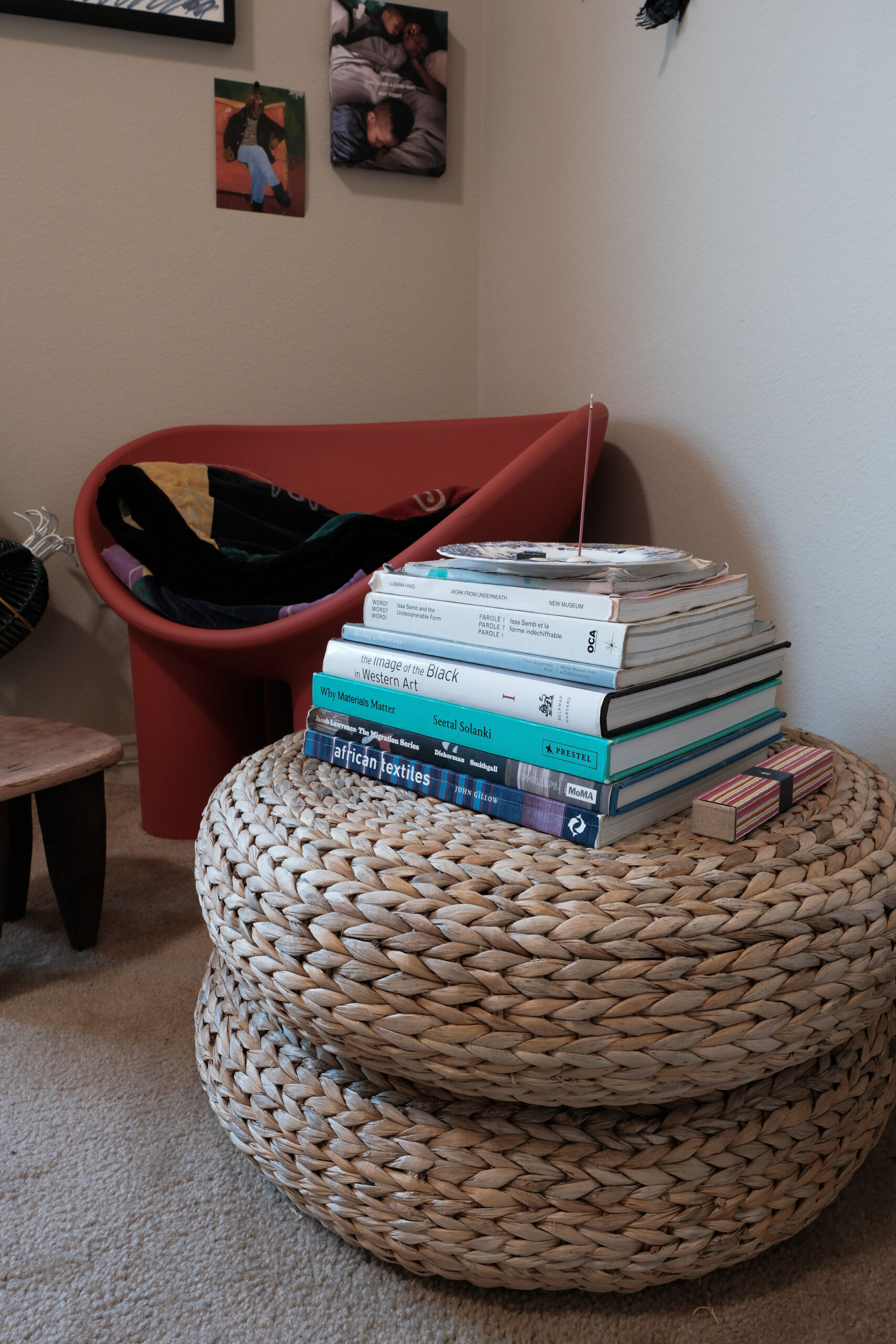
I’ve also got a bunch of different-shaped vases. Sometimes I fill them with fresh flowers and then also I have these dry flowers that I got from Eden Works about two years ago. They’re still around and I love them. Or I put my pens in there, or jewellery. I usually have a bunch of candles too, and lots of books on a variety of subjects from African kings and African textiles to some of my favourite artists, like Lubaina Himid and Gerhard Richter.
Are there any particular materials that you think are important for you to have in your home studio?
I don’t have a preference. As long as it brings me joy. I think joy is very important. It is different from happiness because happiness is a fleeting emotion that comes and goes. But joy is something you choose. I have chosen the things in my home studio because they bring me joy. Like my children’s artwork, which is on the walls, and a series of comics that my son made.
What elements do you think make the perfect home studio?
A space that is always evolving. The goal is for it to become this kind of engine room of possibilities that, when I enter, activates my senses and becomes an agent for change and growth; almost like entering a new portal out of space and time. I’m trying to get mine to point. It’s not there yet. Right now, it feels a lot more zen, and I want it to be much more sensory. But it’s a process.
Do you think there will be an endpoint? Or do you think it’ll be forever evolving?
I don’t think there’s going to be an endpoint. Going back to the idea of humanising materials, I treat that space like a spirit. As a human being you don’t have an endpoint until you die, so it’s the same with that space, it’s going to evolve and change over time because it is a product of my mind and I will grow and change over time.
‘The countryside is my natural environment. I have much more energy when I’m close to nature’
Do you have any daily rituals that help your creative process?
One of the things I learnt during the pandemic is that, for a long time, I had been stuck in either the past or the future. I was always thinking: ‘I should have done this’ or ‘I need to do that’. I was never really in the present and thinking about what I was doing or feeling at that moment.
It wasn’t until I started my routines, especially meditation, that I began to live in the present. Now I wake up in the morning, around 5:30am and read my Bible, do my journaling, and then do my meditation. Those three things set me up for the rest of the day.
I look at my day as a jar, and I have to fill it with big rocks, little rocks and sand. In order to fit everything in, I have to put the big rocks in first, and then the little rocks, and then the sand. If I do it any other way, I’m not going to be able to put everything in. Big rocks are things that cannot be moved, and that have to be a priority, so that’s my routine that I mentioned earlier, which I do when I wake up. Little rocks are the things that are a priority but can be moved. So that’s work, or the podcasts that I listen to. And the sand is more trivial stuff, like music, YouTube or Netflix. That’s how I try to fill up my day. It’s never that clean, but at least I have a guide. And my space helps to create that routine.
How so?
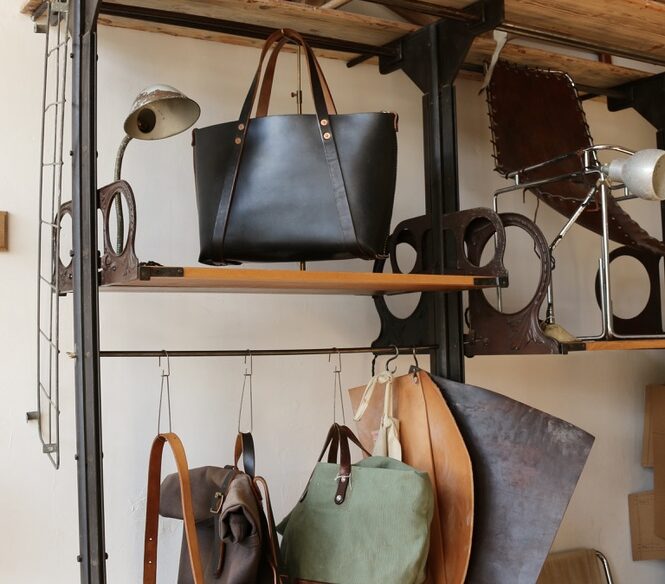
I have designed my office so that I can be more dynamic. If I want to sit at my desk to work, I can. But I also have these platforms attached to the walls – call them bookshelves – and I can perch on them to listen to a podcast or whatever. Then there are some tatami mats that I got from IKEA (I don’t really care for IKEA, but I think these are the greatest things IKEA has ever made) which I can sit or lie on to meditate or burn my incense, or whatever.
How do you get out of a creative rut?
I keep a file of things that inspire me so that, if I feel stuck, I can go to it and there’s always something I can pull from or reference. When people always ask me about creativity, that’s one of the things I recommend for them to do; have a folder of things that inspire you. My studio is slowly becoming a physical manifestation of that folder too; with things and references that inspire me and that I can draw from.
Do you remember the most recent thing you put in your folder?
I’m constantly adding to it. But right now, I’ve been looking at rammed earth architecture, which is an ancient technique where you build with earth. It has a very interesting texture.
Any podcast recommendations?
The Knowledge Project. The Business of Fashion. The Daily Stoic. And Blamo!