Potter Keith Brymer Jones takes a ‘less is more’ approach to his craft
Keith Brymer Jones, potter, writer and television judge, speaks to RAFT about his creative process and the importance of his studio, a space in which he has been ‘conditioned to think creatively’.
Words Meena Sears
Photograph Supplied by Keith Brymer Jones
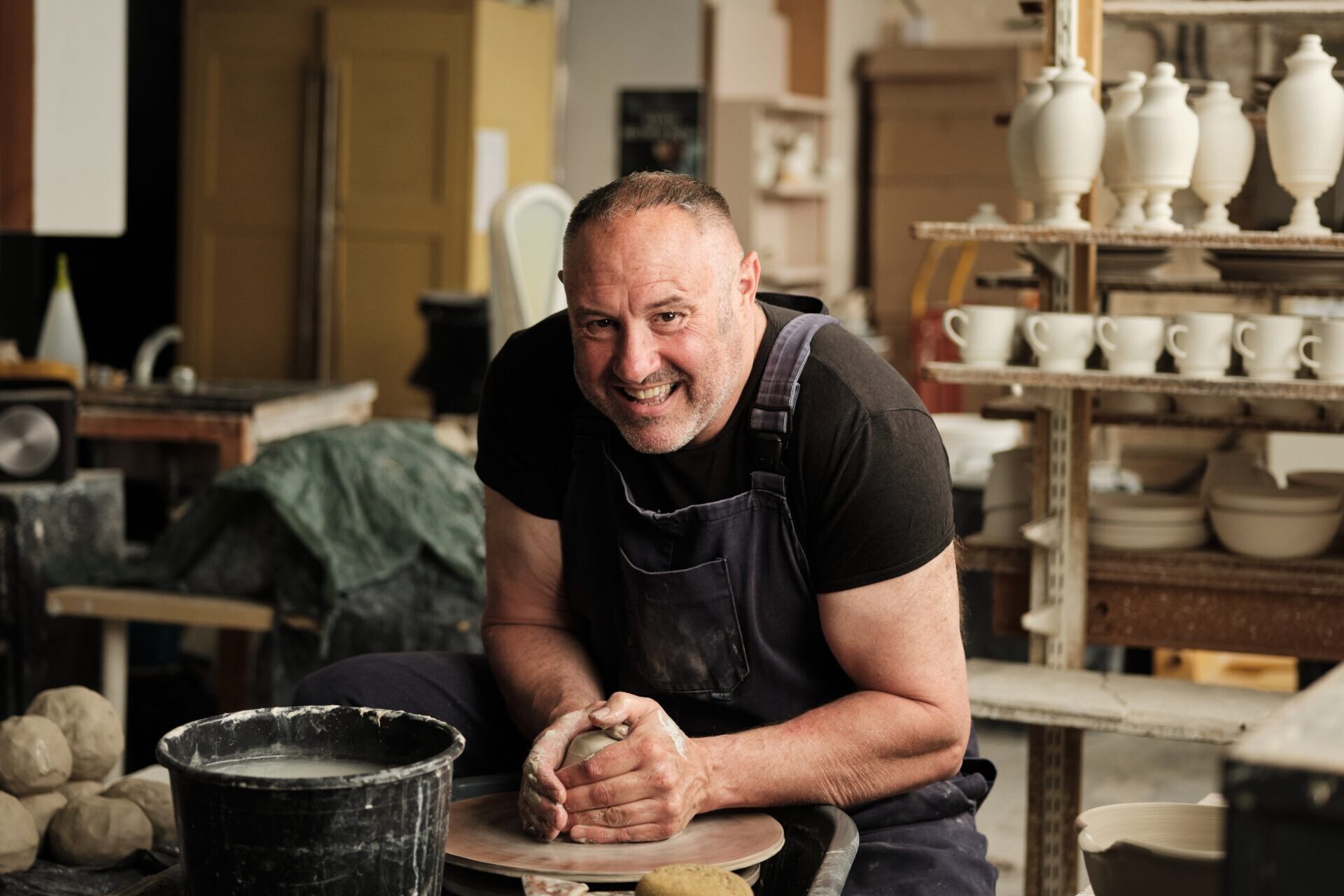
London-born Keith Brymer Jones is a potter, writer and television judge on The Great Pottery Throw Down and The Victorian House of Arts and Crafts. His passion for ceramics was sparked at the ripe age of 11 when, while making a pottery owl, he first felt the escapism that comes from crafting. After a brief stint as the lead singer of a punk band (The Wigs) in the 1980s, Jones took an apprenticeship at Harefield Pottery in London and has been combining traditional ceramic techniques with modern designs ever since. His belief that ‘less is more’ is evident in his distinctive style, which has caught the attention of esteemed retailers such as Conran, Barneys NY, Laura Ashley, and Heal’s.
Keith shared his hole-and-corner with us.
A ‘hole-and-corner’ is an old English term meaning a secret place; somewhere you go to escape the world, to be inspired and to contemplate and create. Where is your ‘hole-and-corner’?
Well, to be perfectly honest, I go to my studio. Working with clay in the studio really makes me think creatively. I think it’s because my brain, over the years, has been conditioned to think creatively in that environment.
Can you explain why it is so special to you?
Clay has been a companion all my adult life, so working with it is, and always has been, my happy place. That, and swimming in the sea. Marj (my partner) and I are moving from Whitstable to Capel Salem, Pwllheli in North Wales; once we move, I will have all the beaches and coves on the Llŷn Peninsula to explore.
Do you think your studio is a physical representation of the inside of your mind?
Yes, very much so. It’s usually very tidy and ordered. I know you wouldn’t really think of me like that, but when things are ordered, I feel freer to explore the more leftfield side of my personality. I was like this when I was in the band; a total nutter on stage as long as everything was ordered in the dressing room.
Is it important for you to have somewhere to escape from the hustle and bustle of life?
Yes, that’s one of the reasons why Marj and I are moving to North Wales; fewer people.
What do you like to listen to when you’re working?
Ah… now this is quite eclectic and somewhat obscure. Either Radio 4 (I love it, and it’s great to listen to when throwing on the wheel), or if I have to rush, Rammstein or high-energy rave music. I love music!
Is it private to you or do you let other people visit?
It’s fairly private; there are only a few people I feel comfortable being around when working.
What elements do you think make a perfect ‘hole-and-corner’?
An environment you can control and somewhere, for me anyway, you can be your most comfortable and creative.
What’s the best advice you’ve ever been given?
From my father (ironically, as it was the only bit of advice he ever gave me): make sure you do something you enjoy, as you’ll be doing it for 85 per cent of your life. He hated his job/s all his life and didn’t want me to make the same mistake.
Can you tell us a bit about your book, ‘Boy in a China Shop: Life, Clay and Everything’?
It’s basically an autobiography; a journey through the algorithms of my life – we all have them.